Piano Refinishing Services in Pasco, WA
A piano's cabinet is as much a part of the instrument as its strings and action. Over decades of use, even the finest piano finishes deteriorate — dulling, yellowing, chipping, scratching, or peeling in ways that diminish the instrument's appearance without affecting its mechanical function. At Dickerson's Piano Service in Pasco, WA, we provide professional piano refinishing that restores the cabinet to a condition that reflects the quality of what is inside it. Whether your piano has surface-level wear or deeply damaged finish, we approach every refinishing project with the precision and patience the work demands.
Ready to restore your piano's appearance? Contact Dickerson's Piano Service in Pasco, WA to discuss your piano refinishing project.
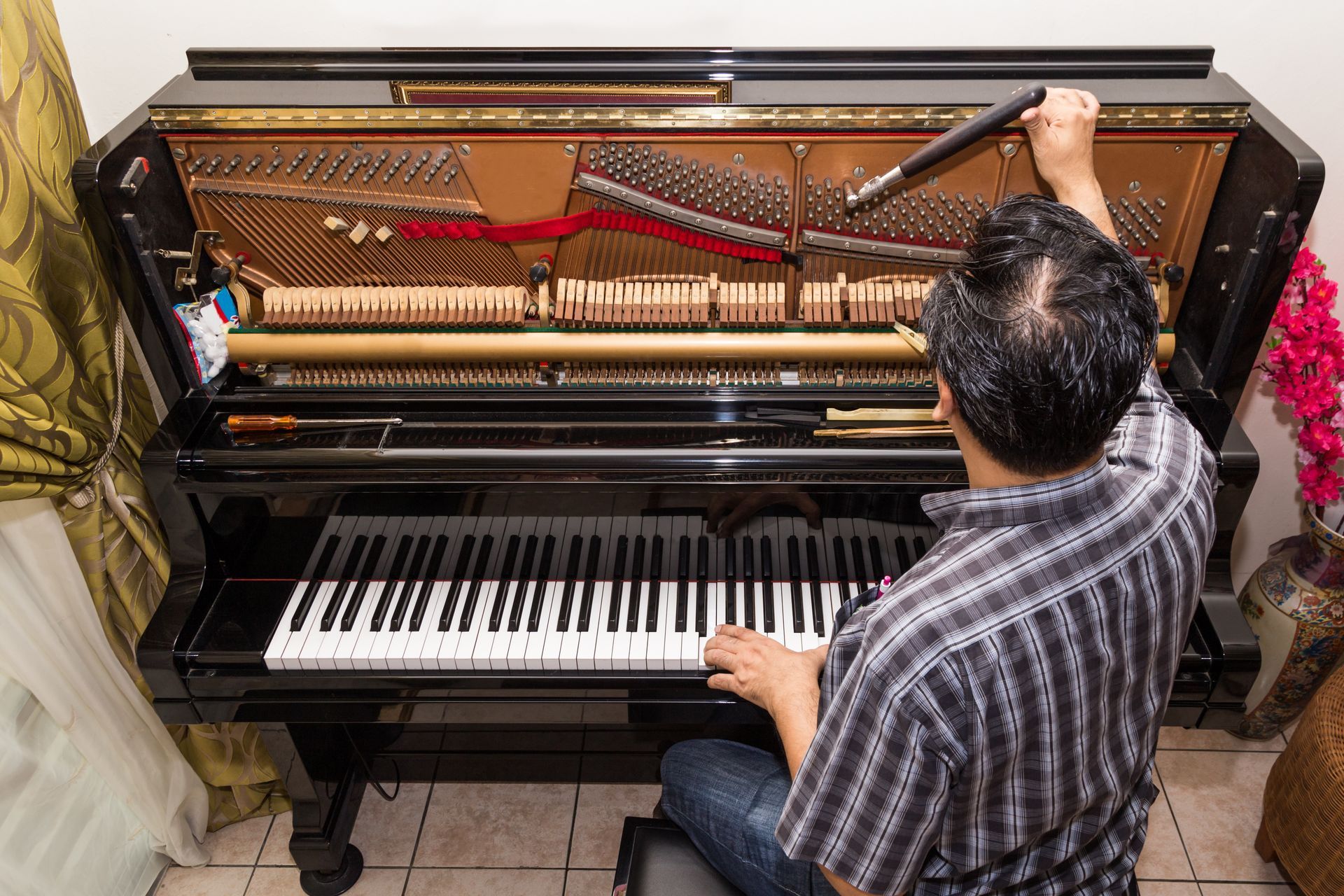
What Piano Refinishing Involves
Piano refinishing is the process of stripping, preparing, and reapplying a finish to the exterior surfaces of the piano cabinet. It is not a simple paint job or a surface polish — it is a multi-stage process that requires careful material removal, surface preparation, and the application of finish products suited specifically to the demands of a piano cabinet.
The cabinet of an acoustic piano is made up of curved and flat wooden panels, moldings, legs, lid sections, music desk, fallboard, and various trim pieces — each of which must be treated individually and refinished to a consistent standard. The complexity of the geometry, the need for color and sheen consistency across all surfaces, and the requirement that the finish be durable enough to withstand decades of use make piano refinishing a specialized discipline distinct from general furniture refinishing.
Call Dickerson's Piano Service in Pasco, WA to learn more about what a professional piano refinishing project involves for your specific instrument.
The Piano Refinishing Process
Every refinishing project begins with a thorough assessment of the cabinet's current condition. The type of existing finish, the extent of damage, the wood species beneath the finish, and the desired final appearance all inform the approach taken.
Disassembly and Component Removal
- Before any refinishing work begins, the piano cabinet is carefully disassembled. Hardware, hinges, casters, pedal assemblies, and all removable components are taken off and set aside. The interior action and key components are protected or removed entirely to prevent contamination from finishing materials.
Stripping the Existing Finish
- The old finish is removed completely using a combination of chemical strippers, heat, and hand tools appropriate to the cabinet's construction. This step must be performed carefully to avoid damaging the wood substrate beneath — particularly on veneered surfaces, where the decorative layer is thin and vulnerable to over-sanding or chemical strippers.
Surface Preparation
- Once the old finish is removed, the bare wood is carefully sanded through progressive grits to create a smooth, uniform surface. Dents, scratches, gouges, and grain irregularities are addressed at this stage. Any veneer damage is repaired before finishing begins.
Finish Application
- The prepared cabinet surfaces receive the new finish in multiple coats, with sanding between coats to ensure adhesion and surface uniformity. The number of coats and the application method vary depending on the finish type selected. Each coat must fully cure before the next is applied.
Final Polishing and Reassembly
- Once the final coat has cured, the surfaces are polished to the target sheen level — whether satin, semi-gloss, or high-gloss polyester. Hardware and all removed components are reinstalled, and the completed cabinet is inspected under controlled lighting to confirm consistency and quality across all surfaces.
Contact Dickerson's Piano Service in Pasco, WA to schedule a refinishing consultation and get a detailed assessment of your piano's cabinet condition.
Finish Types and Options
Not all piano finishes are the same, and the right finish for a refinishing project depends on the original finish type, the piano's age and style, and the owner's preferences for appearance and durability.
High-Gloss Polyester Finish
- The dominant finish on modern production pianos, high-gloss polyester produces the deep, mirror-like surface most people associate with contemporary grand and upright pianos. It is extremely durable, resistant to moisture and scratching, and maintains its appearance well over time.
Lacquer Finish
- Lacquer was the standard piano finish through most of the 20th century and remains the appropriate choice for restoring older instruments to period-correct appearance. It is thinner than polyester and suits the aesthetic of vintage pianos. Lacquer refinishing is available in a range of sheen levels from satin to gloss.
Satin and Semi-Gloss Options
- Satin and semi-gloss finishes offer a more understated, furniture-like appearance that suits certain cabinet styles and home environments. These finishes are available in both lacquer and polyester systems depending on the desired durability and application method.
Discuss finish options with Dickerson's Piano Service in Pasco, WA — we will help you select the right finish type for your instrument and your expectations.
Color Changes and Custom Refinishing
Piano refinishing does not have to mean returning the instrument to its original color. Many piano owners choose refinishing as an opportunity to change the cabinet color entirely — converting a dark walnut upright to a satin black finish, or refinishing a worn black grand in a custom color to suit a particular interior.
Color changes require additional preparation steps, including sealing and priming the substrate appropriately for the new finish color. Coverage consistency and color accuracy are critical when refinishing to a specific color, particularly on instruments with curved surfaces where light reflection varies across the cabinet geometry.
If you are considering a color change as part of your piano refinishing project in Pasco, WA, contact Dickerson's Piano Service to explore what is possible for your instrument.
Frequently Asked Questions About Piano Refinishing in Pasco, WA
How Do I Know if My Piano Needs Refinishing or Just Polishing?
Surface haze, minor scratches, and dullness that affect only the top layer of the finish can sometimes be addressed with professional polishing or a glaze coat without full refinishing. Peeling, flaking, deeply scratched, or structurally compromised finish — where the damage has reached the wood substrate — requires full refinishing. We assess the cabinet condition and recommend the least invasive approach that achieves the desired result.
How Long Does Piano Refinishing Take?
A full refinishing project typically takes several weeks from start to completion. The timeline depends on the size and complexity of the cabinet, the finish type selected, the extent of surface preparation required, and cure times between coats. Rushing the process compromises the finish, so we do not cut cure times short regardless of scheduling pressure.
Will Refinishing Affect My Piano's Sound?
When performed correctly, cabinet refinishing does not meaningfully affect the acoustic performance of the instrument. The soundboard, bridges, and strings are protected during the process. A finish that is applied too thickly to soundboard-adjacent panels could theoretically affect resonance, but this is avoided by working with appropriate finish thicknesses and protecting interior components throughout the process.
Can a Piano With Veneer Damage Be Refinished?
Yes, in most cases. Veneer damage — lifting edges, chips, cracks, or missing sections — is repaired during the surface preparation stage before any new finish is applied. Matching veneer for repairs can be challenging on older instruments with unusual wood species, but in most cases a repair can be achieved that is not visible under the new finish.
Is Piano Refinishing Worth the Cost on an Older Instrument?
The answer depends on the instrument's overall condition, its structural integrity, and the owner's attachment to it. A piano with a solid pinblock, intact soundboard, and functional action can provide many more decades of use after refinishing — and a restored cabinet dramatically improves both its appearance and its resale value.
Can I Refinish Just Part of the Piano Cabinet?
Partial refinishing is possible but presents significant challenges in matching the new finish to the existing finish in terms of color, sheen, and texture. In most cases, the visual difference between a freshly refinished panel and an aged surrounding finish is noticeable. We discuss the realistic outcome of partial refinishing honestly before proceeding.
What Finish Do Most Modern Pianos Have?
Most pianos manufactured after the 1980s use a high-gloss polyester finish, particularly for black instruments. This finish is applied in thick coats and buffed to a deep, glass-like surface. Older instruments typically have lacquer finishes, which are thinner and have a different visual quality.
How Do I Care for a Freshly Refinished Piano Cabinet?
A newly refinished piano cabinet should be dusted with a soft, dry cloth and cleaned only with products appropriate for the finish type. Avoid silicone-based furniture polishes, which can contaminate the finish surface and cause adhesion problems with future refinishing. Keep the piano away from direct sunlight, heating vents, and air conditioning units.
Can a Piano Be Refinished in a Color Other Than Black?
Yes. While black is by far the most common piano finish color, pianos can be refinished in virtually any color. Walnut, mahogany, white, and custom colors are all achievable with the correct preparation and finish system. Color consistency across curved and flat surfaces requires careful technique.
Does Refinishing a Piano Increase Its Value?
A professionally refinished cabinet can meaningfully improve a piano's resale value, particularly for instruments that were in poor cosmetic condition. Buyers respond to appearance, and a piano that looks well-maintained commands more interest and a higher price than an identical instrument with a deteriorated cabinet.